Saturday, April 24, 2021

Blog Entry #2: Portrayals of Gendered Violence in Horror and Exploitation Cinema

Content Warning: This post discusses cinematic depictions of gendered sexual assault and violence.
    
Growing up, my parents didn't put a lot of boundaries on the media I was allowed to consume.  Some of this can be chalked up to them being young parents, some of it their mistaking my precociousness for actual maturity, but whatever the case, whether it be flipping the channels or browsing the video store racks, I was given pretty much free reign to entertain myself.  Some of my earliest memories are of sitting rapt before a television set watching David Cronenberg's 1986 remake of The Fly and giggling to the (increasingly, as the series wore on) comedic stylings of Freddy Krueger, a supernatural child murderer who was inexplicably popular with children, mostly on account of having blades for fingers and a cheesy pun for every set piece.  As my horror fanaticism grew and I started my way through the video store's selection, I soon wound up in increasingly choppy waters.  What my parents were thinking letting a nine-year old me rent films like I Spit on Your Grave or Last House on the Left I'll never know, but both of those films, belonging to the rape-revenge subgenre, made an indelible impact on my young psyche.  While both films had (and continue to have) their detractors, I would argue that, despite being exploitation films wrought by male filmmakers, both films managed to portray gendered violence as awful, inhumane, and sans titillation, and are more (even if odiously) powerful for it.  Unfortunately, the gravity with which sexual assault and gendered violence was portrayed in these films is the exception and not the rule, as in most of exploitation and horror cinema, assaults on women were treated as an attraction: a means to assure more nudity, a "sex scene" even if one without two consenting parties, or, even when the violence isn't sexual on the surface, violence that mirrors sex in such a way that it is problematic, to say the least.  In this blog entry, I hope to explore the wide chasm that exists between portrayals of gendered violence in genre film, and to consider the ways in which filmmakers can more effectively approach such subject matter in a way that is not merely exploitative, but which instead manages to invoke the consequences of and emotional devastation that results from gendered violence, as opposed to basically functioning as a puritanical, gory version of pornography.


Photo Credit: 20th Century Studios

    
One of the first things to consider when looking at the horror and exploitation genres is who the films are generally being pitched to: young, straight men.  Laura Mulvey expounds on this in her classic treatise on the male gaze "Visual Pleasure and Narrative Cinema": 

"The man controls the film phantasy and also emerges as the representative of power in a further sense: as the bearer of the look of the spectator, transferring it behind the screen to neutralize the extra-diagetic tendencies represented by woman as spectacle. This is made possible through the processes set in motion by structuring the film around a main controlling figure with whom the spectator can identify [...] he projects his look onto that of his like, his screen surrogate, so that the power of the male protagonist as he controls events coincides with the active power of the erotic look, both giving a sense a satisfying sense of omnipotence." (Mulvey, 1975)

Simply put, most cinema is made for men's viewing pleasure, with what is portrayed onscreen being meant to create a sense of identification with the protagonist.  With this in mind, one could be forgiven for thinking the majority of movies in the 'slasher' genre subvert this tendency considering the trope of the "final girl."  In the 'slasher' subgenre of horror film, pioneered by John Carpenter's 1978  Halloween, the protagonist is typically a female character: a female character whose virginity and virtue, her embrace of the kind of values that would assuage the anxiety of a male spectator following the advancements of the second wave of feminism, ensure her survival from the murderous advances of who the male spectator is actually intended to identify with: a (in most cases) blank slate of POV shots set on violently punishing those, particularly female, who transgress from the idealized notion of femininity. As Brewer (2009) notes: "On most measures, the non-surviving female characters were more frequently more sexual or appeared more sexual than the surviving females as well as the non-surviving males within each film."  While there is a great deal of apologia from a feminist perspective about the "final girl" and how she causes a male audience member to identify with an imperiled woman, turn your attention to how director Anna Biller describes viewing an exploitation film in the cinema and the effect it had on female members of the audience

"I once attended a screening of THE  SWINGING BARMAIDS where there were hordes of young women in leather jackets screaming at the screen and rooting for the killer as he ripped the sexy young woman's clothes off and proceeded to rape and slaughter her. Their sentiment was something along the lines of, "Haha, die, bitch! Yeah! Get your slut clothes ripped off so we can see your pathetic man-pleasing whore body, and let’s see that body mutilated! No more GIRLY GIRLS!" (Biller, 2014)


Mari and Lucy, the ill-fated kidnapping victims in Wes Craven's The Last House on the Left. Photo Credit: Sean S. Cunningham.

    To examine the different ways that gendered violence is portrayed in the horror genre, it is helpful to turn one's attention to a film I mentioned in my opening paragraph and the subsequent film series made by one of it's creators.  One of the defining horror films of the 1970's, ushering in the "rape-revenge" subgenre in which a woman is sexually assaulted before revenge is dealt to those who violated her, The Last House on The Left (1972) was written and directed by Wes Craven, who would later helm 1984's A Nightmare on Elm Street, one of the more legitimately interesting slasher films, and produced by Sean S. Cunningham, who would go on to produce and direct the slasher film whose franchise would duke it out the various Nightmare on Elm Street sequels throughout the 1980's: Friday the 13th (1980).  Last House, a riff on Ingmar Bergman's The Virgin Spring, concerns Mari and Lucy, two 17-year old friends who celebrate the former's birthday by leaving their upstate New York home to attend a concert in the big city.  While trying to score some marijuana, the girls are kidnapped by the cruel Krug and his gang (including a feral lover named Sadie- shades of the Manson family, a drug-addled son, and a switchblade wielding sex offender) and subjected to horrible degradation before being murdered in a wooded area coincidentally close to where Mari's parents live.  From there, the film takes an (albeit ultraviolent) page from The Virgin Spring with Mari's parents discovering what has happened to their daughter and taking revenge into their own hands.  Craven, an academic who found his way into low-budget cinema, based the gritty, hand-held footage of the gendered violence in the film's harrowing, uncomfortable middle section not on fantasy but on the realities portrayed all over television news at the time and on the covers of magazines, the actual gendered violence that occurred during the My Lai Massacre, a subject that often came up when defending the film: In the documentary American Nightmare, Craven discussed the famous picture of a girl suffering burns from the napalming of the village Trang Bang as his ‘coming of age into realizing that Americans weren’t always the good guys and that things we could do could be horrendous or evil or dark or impossible to explain: My Lai, for instance’" (Simon, 2000) The footage and acts portrayed are graphic, impossible to enjoy, and all-too-real.  Ample attention is paid to facial expressions, and when Mari is finally shot and left to die, the murderous gang are overcome with disgust over what they have done.  I would argue that, while a terrible ordeal to sit through, and while somewhat cheapened by it's narrative resolution, which allows for one of the murdered girl's parents to extract revenge (a definite divorce from the realism of the middle section), the way gendered violence is portrayed here is actually a more responsible way of portraying such acts and creates a great deal of empathy with the victims than the altogether less graphic, special-effects heavy dismemberings in Friday the 13th and it's sequels.

I don't know about you, but am I alone in feeling there is something awfully phallic about Mr. Voorhees' machete here? Image Credit: Paramount Pictures

    In the Friday the 13th series, camp counselors at Camp Crystal Lake are slayed by a murderer, in the first film, Mrs. Voorhees seeking revenge for the drowning death of her young disabled son Jason, and in the sequels, Jason himself seeking revenge for his mother's beheading in the first film of the series.  All of the films in the series feature the "final girl" trope, and are relatively scare-free and cliche-prone, existing solely to string together a series of murders and gore-effects, most of which were excised from the films before release so that the film might receive an R-rating.  What is troubling is, as stated before, the rationale behind who is murdered, how this murder acts as a substitute for a sexual act, and through whose eyes we view this sexual/violent act through.  "[F]rom the viewer's perspective, it is imperative that the killer be male, even though his identity is often unknown until the end of the film; therefore, throughout the film, it is up to the viewers to subjectively decide that the killer is male based on assumption of social norms and the perspective through which filmmakers tell the story." (Brewer, 2009)  This assumption is because of how the filmic technique most used- point-of-view, often accompanied by heavy breathing, seeks not only to obscure the identity of the killer, but to put us (and by us I mean the male audience member) in the killer's shoes.  I can't help but think of heterosexual pornography, much of which is shot point-of-view, and that which isn't is so preoccupied with portraying the female performer as spectacle that the male performer's face is often kept offscreen for the majority of the sexual act.  In contrast to the non-descript nature of the penis-wielding male porn performer or the knife-wielding maniac, the woman onscreen will invariably be lavished with attention- dressed in a revealing manner before being engaged in a violent, penetrative act (notice the slasher most often uses a knife, a poker, or something similarly phallic and thrustable versus, say, a shooting at a victim from a distance, or bopping them over the head with a hammer).  As stated by Mulvey (1975) "In their traditional exhibitionist role women are simultaneously looked at and displayed, with their appearance coded for strong visual and erotic impact so that they can be said to connote to-be-looked-at-ness.  Women displayed as object is the leit-motif of erotic spectacle: from pin-ups to strip-tease, from Ziegfield to Busby Berkeley, she holds the look, plays to, and signifies male desire."  More scary to most straight male audience members, then or least the male filmmakers churning out slasher movies, is the mix of castration-fear and fear-of-rejection that a beautiful woman-object represents to a man in a society increasingly shifting away from patriarchy.  Thus it is that a Jason Voorhees is able to allow the male spectator the chance to vicariously lash out violently against the women who represent their weakness/insecurity in a way that mirrors the sex scene in a porn film: there is build up, foreplay, the act itself, followed by a "money shot", only with the woman's blood in place of other bodily fluids, the end result being the spectacle having been "destroyed", humiliated, and made lesser than. 

For a more in-depth look at the Final Girl trope, check out The Take's excellent, in-depth dive into the concept, it's implications, and it's evolution with "The Final Girl, Explained." 

    When contrasting the approach to gendered violence in something like Friday the 13th to that of the something a bit more considered like The Last House on the Left, which wants you to empathize with the victim and the terror they experience through gendered violence, it perhaps goes without saying that the latter, for all it's reputation as being obscene and rough and less-acceptable than your Paramount Studios-funded popcorn slasher flick, is actually in-line with the reality of the violence women experience versus the male domination fantasy on display in the former.  When I'd sit before the TV screen as a kid with my action figures, I definitely know that one of these films inspired within me a deep revulsion and a recognition that horror exists in the real world and is awful, whereas the other I would generally ignore except to look up and cheer on someone getting a knife rammed through their head or fire poker shoved through their gut.  I'm a huge horror fan, but I know I for one am sick of being made to identify with mute, hulking non-entities whose value system (and it's accordant hypocrisy) is not that far removed from your average Trump voter!  I'm also sick of this idea that the "final girl" trope is some kind of subversive feminist statement: yes, there are instances where a good argument can be made for this, but if the woman's survival generally hinges on the fact that she's "saving herself for marriage" or that she doesn't indulge in "masculine" vices like drinking, how feminist a statement is that trope really?

Stacie Ponder's excellent blog, Final Girl, offers a female perspective on the slasher films of the 1970's and 1980's and is a fun read even if you're not particularly keen on the genre!

Works Cited

Biller, A. (2014, January 14). The Misogyny of the Modern Slasher Film. Anna's Blog. http://annabillersblog.blogspot.com/2014/01/the-misogyny-of-modern-slasher-film.html.

Brewer, C. (2009). "The Stereotypic Portrayal of Women in Slasher Films: Then Versus Now" (2009). LSU Master's Theses. 56. https://digitalcommons.lsu.edu/gradschool_theses/56

Mulvey, L. (1975) Visual Pleasure and Narrative Cinema. Screen, 16(3), 6-18. https://doi.org/10.1093/screen/16.3.6

Simon, A [director]. (2000). The American Nightmare [DVD]. Minerva Pictures.

Rovner, J. (2021, April 13). Juvenile Life Without Parole: An Overview. The Sentencing Project. https://www.sentencingproject.org/publications/juvenile-life-without-parole/.


Thursday, March 25, 2021

Blog Entry #1 : Objectification 101: The Music Video and the Straight, Cisgender Male Gaze


Being born in the mid-eighties, watching women gyrate behind hyper-aggressive rappers and spandex-clad hair metal shriekers on MTV just prior to Nirvana’s ascendancy form some of my earliest memories.  As I wasn’t quite inured to the ins and outs of sexuality (and puberty was still some years away) I generally regarded this as a good time to ignore the television screen for my toys until the next slapstick Fresh Prince and Jazzy Jeff or Biz Markie video, which appealed much more to someone who regularly wrote and addressed letters to (and was disappointed to never hear back from) Bugs Bunny and Mighty Mouse.  As hair started growing in odd places and my general thoughts of female classmates and peers (generally “yuck!”) gave way to, well, yucky thoughts about female classmates and peers I found myself increasingly drawn to the music videos I’d have once ignored.  By the time I’d entered junior high, the likes of Juvenile’s “Back That Azz Up” and Britney Spears “Baby One More Time” videos not only held me at rapt attention, but undoubtedly contributed to sexist behaviors and attitudes it would take more than a few years and long-term romantic relationships to improve on.  I’m not saying Jay-Z, for example, is the reason I spent the better part of my teens and early twenties exhibiting problematic behaviors towards the opposite sex but growing up in an environment in which Dame Dash and the members of UGK can pour champagne all over a reclining, bikini clad woman’s breasts in the “Big Pimpin’” video certainly didn’t help matters. While in an age in which children can readily find pornography on their phones before they can even spell “boob” music videos aren’t quite the gateway drug they once were to terrible ideas about women, the art form remains one made with a male gaze and an attitude that women are accessories or adversaries; objects of lust, ridicule, and even violence.  It is high time to examine an artform that, for all of it’s technical and stylistic innovations remains firmly retrograde in its approach to women (even when female artists are at the helm): the music video.

Dame Dash in Jay-Z's "Big Pimpin" video
Photo Credit: Roc-A-Fella via MTV

In Performing Gender: A Content Analysis of Gender Display in Music Videos, Cara Wallis found upon a review of 34 videos that had played on MTV and MTV2 that women were far more likely to sexually touch themselves, dance suggestively, and glance in a “seductive” manner (2011) when compared to their male counterparts.  This should come as little surprise to anyone familiar with advertising: however much the music video is an artform, it is ultimately a promotional tool used to encourage the consumption of a product and, frankly, sex sells.  So it is that when courting a heterosexual male audience, forging an association between sex and an artist’s tunes is one of the surefire means of ensuring success.  That the sexual association is based around a commodification of objectified female sexuality in a way that appeals to male ego fantasies versus a more nuanced, realistic understanding of feminine sexuality shouldn’t come as much of a surprise.  Not only is a straight cis male the individual most often marketed to, but these are most often the individuals behind the camera creating the music videos.  Amy Mole, of the Bird’s Eye Film Festival, estimates that only seven to twelve per cent of film directors are women, a statistic that must also be true of music videos. (Love, 2011) When men control the reigns of producing, directing, and shooting music videos, it goes without saying that the “male gaze” is the predominant one, and furthermore that a liberal injection of feminist theory, feminist film theory in particular (the concept of the “male gaze” specifically) is needed to truly grasp the reasons for and ramifications of this sad fact.

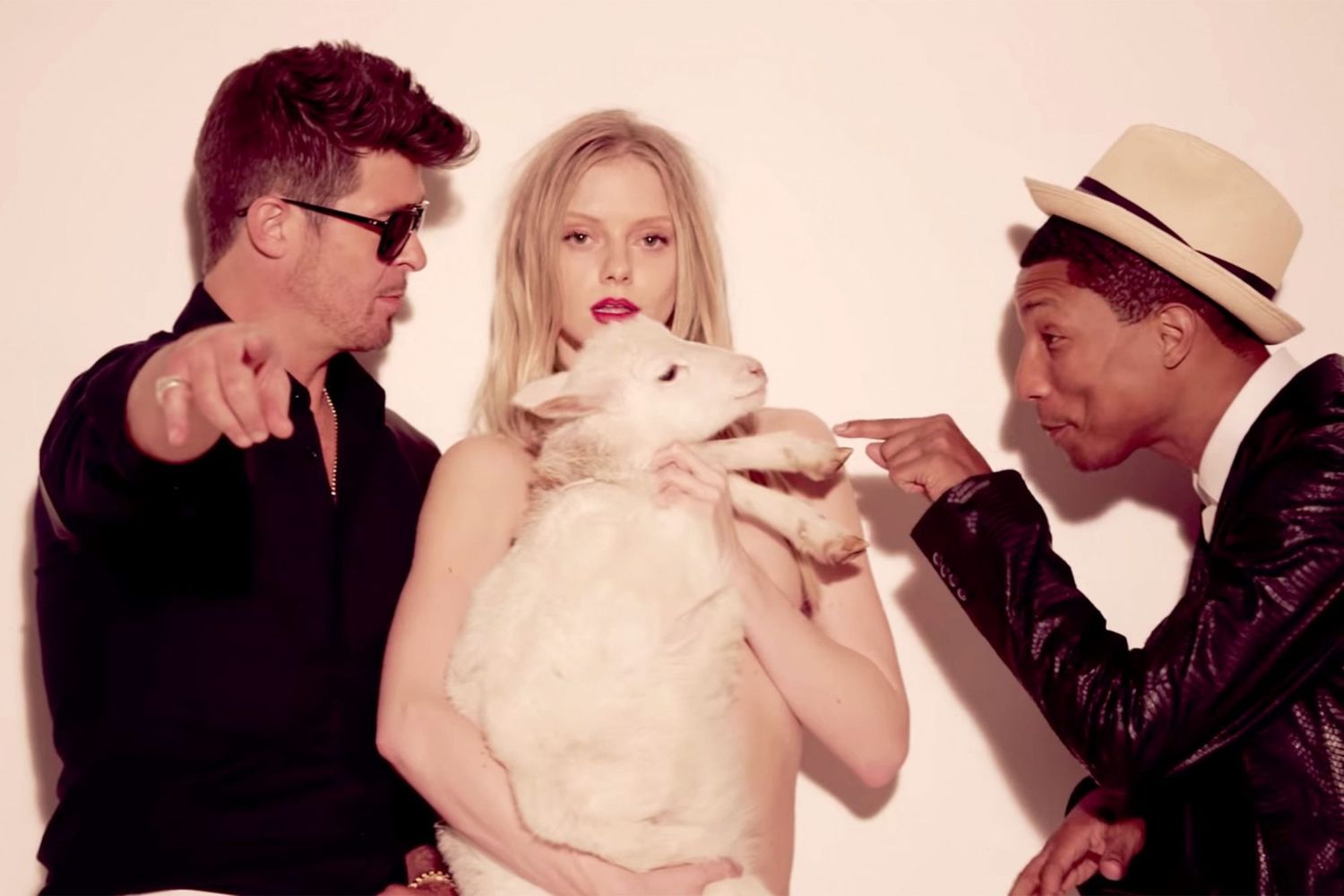
Coined by scholar and filmmaker Laura Muley in her 1975 essay Visual Pleasures and Narrative Cinema, the concept of the male gaze is that women are positioned before the camera as the “object” of heterosexual [cisgender] male arousal. (Loreck, 2020) While it can be argued that there are attractive actors onscreen, there is no doubt that agency and personality tend to be reserved far more often for men. In the non-narratives and extremely abridged narratives of the music video, this is made all-the-more apparent.  Whereas the object of sexual desire in a Hollywood movie might at least have a few lines of dialogue (even if just to stroke the ego of the protagonist), music videos can blatantly use women as props and be unapologetic in doing so.  One of the biggest (and most controversial, now almost universally reviled) pop hits of the past decade was Robin Thicke’s date rapey Marvyn Gaye-pilfering Prince-as-a-rich-white-actor’s-son “Blurred Lines” from 2013; beyond the lamentable lyrics (“you know you want it!”) was the uncensored version of the music video, which featured nude models dancing amid a white background while Robin Thicke, producer Pharrell Williams, and rapper T.I. grope, prod and gawk at the young women.  At one point balloons smell out “ROBIN THICKE HAS A BIG DICK” as though it isn’t on-the-nose misogynistic enough.  (I’d link the video for a point of reference, but it (a) doesn’t deserve the views and (b) you can get a pretty good sense of what entails in the video if you’ve ever seen an American Apparel ad.  Just imagine one of those, in motion, but minus the clothing).  In the wake of #METOO and Time’s Up, even some of those involved in that risibly outdated video have come to regret their participation in the song and video (and not just because the estate of Marvin Gaye sued and won royalties for the wholesale pilfering of a far superior Gaye track for the beat). Pharrell Williams later went on record as being embarrassed by the song and video, pointing out how growing up in a culture in which he was surrounded by advertising likely had an effect on his seeing nothing wrong in the moment with “Blurred Lines.” (Shaffer, 2019) Mulvey’s discourse on the “male gaze” includes expounding on the idea of scopophilia, the sexual pleasure one derives from watching.  Women provide “spectacle” while men function as the “observer”. (Loreck, 2016) Voyeurism, my dear Watson! In “Blurred Lines”, this is readily apparent- a nude woman clutching a lamb draws the eye away from the besuited men being creeps on their periphery, and the men in the video in fact because a stand-in for the viewer.  They are signaling that you too must gawk at these lithe, nude women, and perhaps imagine balloons announcing to the world that you too have a large penis.  This is arrived at in a most insidious fashion, as film speaks in a language of structures that are strong enough to allow temporary abdication of one’s own ego, while simultaneously reinforcing said ego. (Mulvey, 1975) Simply put, the music video you are watching encourages you to take a backseat and adopt its viewpoint, and in doing so, it reinforces your belief in similar viewpoints by means of momentarily “borrowing” your conscious attention.  To paraphrase Nietzsche (not something I expected to type when I began writing this) “If you gaze long enough into the twerking posterior, the twerking posterior will gaze back into you.”

Still from "Blurred Lines" video
Photo Credit: Vevo via Entertainment Weekly

"Everything Wrong With Robin Thicke's "Blurred Lines": YouTube channel Music Video Sins has a go at the censored (clothes on) version of the "Blurred Lines" video, commenting often on the sexism, misogyny and cringe therein in side-splitting fashion.

Even more troubling is when one looks at the intersection of race and gender in the music video.  Women of color, black women, are reduced almost exclusively to sexualized portrayals, in not only videos by male artists, but by female artists as well, many of whom are ostensibly attempting to subvert the male gaze, but simply by means of mimicking and “owning” it instead of countering it in a way that is perhaps more meaningful?  While one can make solid arguments that videos like Cardi B’s ‘WAP’ or Nicki Minaj’s “Anaconda” are sex-positive and are the work of women celebrating their own sexuality (which isn’t wrong), it is worth noting that both of the hypersexual videos are the work of male director Colin Tilley, and should one dub over the rapping with male rappers and maybe digitally insert one or two ogling at the behinds of the artists both videos would be all but indistinguishable from the kind of videos I once found myself transfixed by during the salad days of my pubescence.  Even when extolling feminist or sex-positive messages, black women are still expected to do so by twerking and flaunting the kinds of sexual stereotypes that have hounded black women since the dawn of this country, when they were considered little more than property (the logical endpoint of objectification- out and out ownership).  As Frisby and Aubrey put it:

“Hip hop scholars have argued that the sexual stereotypes of African American women found in hip hop music videos—such as the Diva, Gold Digger, Freak, and Baby Mama—inform and reflect broader beliefs about Black women’s sexuality (Stephens, 2007). In male artists’ music videos, female characters are often used as props, there for decoration but otherwise ignored (Arnett, 2002). Yet even when women are the featured artists, they still put themselves in sexually submissive positions in their own videos (Dixon & Brooks, 2002, 2007; hooks, 1992).” (2012)

How Women Are Portrayed in Hip-Hop VideosThis YouTube video examines the portrayal of women in hip-hop videos, with different experts and commentators considering the degree to which such portrayals are problematic.

In the wake of the five leaps back progress-wise that was the Trump presidency, it seems that one of the net positives of that era is the realization that only mild progress has been made in the entertainment industry where women are concerned, in terms of representation, treatment, and power behind the camera (or awareness, anyways).  I hope that with the renewed attention on these imbalances that female creators can take the reigns of how they are portrayed in their own media and that they can do so in a way that is at a remove from the tradition of the camera lens being a stand-in for the libidinous male voyeur.  And even if some of the conventions remain the same, as in the aforementioned “WAP” and “Anaconda” videos, perhaps get some female talent in the director’s chair?  I know there have been major strides in terms of the representation and popularity of LGBTQ artists, from Frank Ocean to 100 Gecs and beyond, who’ve have managed to push back at the cisgender, straight male gaze that we’re typically forced to look at the world through, and I’m positive that women as a whole will increasingly be able to do so, at least so long as the media and industry are being kept on their toes and held accountable for contributing to such a toxic environment.  Additionally, I am hopeful that young, impressionable men will be faced with more honest, complex depictions of women and their sexuality, depictions that portray the women as, you know, human beings, with autonomy, versus being “hos” and “sluts”, which was the attitude that was Trojan horse’d into my head at a time when the women in my life could have really benefitted from my not subtly absorbing the messages of, say, Eminem or Limp Bizkit or whatever it was that was pushed on 12-year old me as being “cool.”

Cardi B and Megan Thee Stallion in the "WAP" video 
Photo Credit: YouTube via NME

How the music videos of the 2010s saw women take back power: Dazed Digital takes a look at women reclaiming music video power in the 2010s and raise a lot of interesting questions in the process.  For example, for all the invective I've hurled at the video for "Blurred Lines", does it complicate matters that it directed by a woman?  Is Rihanna's "BBHMM" an empowering middle finger to the white power structure or are the visuals of Rihanna kidnapping and murdering her accountant's wife sexist and despicable?  Worth a read and features the videos it explores embedded within the page.

References

Frisby, C., & Aubrey, J. (2012). Race and Genre in the Use of Sexual Objectification in Female Artists’ Music Videos. Howard Journal of Communications, 23(1), 66–87. https://doi-org.lib-proxy.fullerton.edu/10.1080/10646175.2012.641880

Loreck, J. (2020, April 22). Explainer: what does the 'male gaze' mean, and what about a female gaze? The Conversation. https://theconversation.com/explainer-what-does-the-male-gaze-mean-and-what-about-a-female-gaze-52486.

Love, E. (2011, October 23). It's time for women to call the music video shots. The Independent. https://www.independent.co.uk/arts-entertainment/music/features/it-s-time-women-call-music-video-shots-1920051.html.

Mulvey, L. (1975) Visual Pleasure and Narrative Cinema. Screen, 16(3), 6-18. https://doi.org/10.1093/screen/16.3.6

Shaffer, C. (2019, October 14). Pharrell Says 'Blurred Lines' Controversy Educated Him About Sexism. Rolling Stone. https://www.rollingstone.com/music/music-news/pharrell-blurred-lines-sexism-chauvinist-898544/.

Wallis, C. (2011). Performing Gender: A Content Analysis of Gender Display in Music Videos. Sex Roles, 64(3–4), 160–172. https://doi-org.lib-proxy.fullerton.edu/10.1007/s11199-010-9814-2